
35 Years of the ADA; Progress, Gaps and the Case for Disability Employment
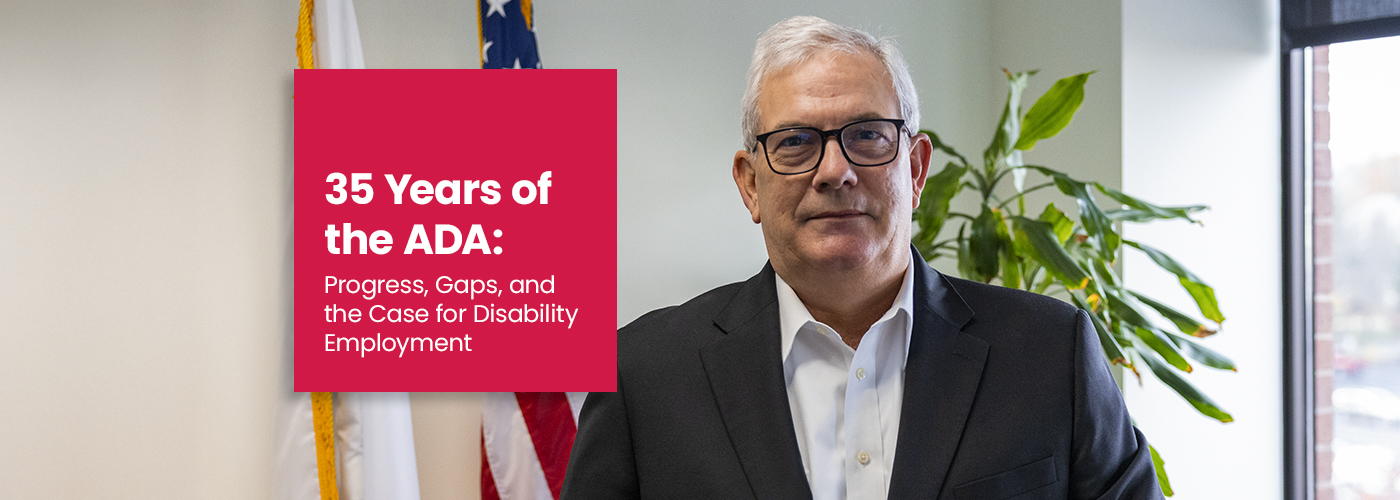
This July, the United States marked the 35th anniversary of the Americans with Disabilities Act (ADA) — a landmark federal civil rights law that reshaped our nation and disability employment.
The milestone marks a moment of progress, and as we reflect on this anniversary, we should be proud of the strides made to advance employment opportunities for people with disabilities. The ADA promised full participation, independent living and economic self-sufficiency. For many, that promise has been fulfilled. However, while we celebrate how far we've come, we must also acknowledge how much work remains. Disability employment is advocacy in action, and it must remain a national priority.
Disability Employment Progress Since the Passage of ADA
In the past three and a half decades, disability employment has strengthened the workforce and economy and our national security through domestic manufacturing. The ADA catalyzed essential shifts in accessibility and workplace rights, and more recently, the post-pandemic rise of flexible work arrangements and new technologies have opened doors to even greater opportunity.
Disability Employment: A Lasting Legacy of the ADA
SourceAmerica®'s national nonprofit network, which includes nearly 500 nonprofit agencies, empowers 59,000 people with disabilities through meaningful employment including working on federal product and service contracts. Our network supports military readiness and "Made in America" mandates by manufacturing, assembling and delivering mission-critical products and services for federal agencies and the military.
The proof lies in personal success stories, such as William "Scotty" Weatherly, who began working on an AbilityOne® contract with Goodwill Industries of San Antonio and rose to manage a team of 70 employees handling veterans' medical and dental records. Proof is also found in organizations like the Brevard Achievement Center, which supports NASA's space mission by employing people with disabilities in critical roles.
These success stories in disability employment illustrate how the AbilityOne Program and SourceAmerica's network empower individuals to advance their careers, gain independence, and support federal missions; all while strengthening our economy.
An Economic Imperative
Disability employment is a force for positive change as well as an economic imperative and a living expression of the ADA's enduring legacy. Employees in SourceAmerica's network of AbilityOne federal contractors fulfill essential federal contracts and directly support our nation's defense by outfitting and feeding our troops, maintaining military vehicles and bases, delivering mail to service members, supporting NASA missions, and more.
The Program is also financially sound. For every $1 spent to administer the AbilityOne Program, the return on investment averages $2.66, and can be as high as $4.40, These numbers are powerful, and the potential to strengthen our economy through increased disability employment is even greater.
Why Disability Employment Matters
Disability employment has a broad national impact. People with disabilities contribute daily to government efficiency and military readiness, which remains vital in today's uncertain global climate. Our economic and defense capacity is only as strong as our workforce, and that workforce should reflect the full breadth of our country's talent.
This impact is especially meaningful for our nation's veterans. More than 2,800 veterans with disabilities are employed through SourceAmerica's network. For them, disability employment honors their dignity, builds independence and provides upward mobility, while reducing reliance on government assistance, strengthening the economy and bolstering our defense.
The Barriers to Disability Employment that Remain
Despite 35 years of progress, employment barriers for people with disabilities persist. Policy gaps in federal contracting, limited disability employment procurement practices, and outdated perceptions continue to restrict access to meaningful work. We must continually improve and protect the AbilityOne Program, which remains a key driver of accessible federal employment.
The data underscores this urgency. According to the U.S. Bureau of Labor Statistics, in 2024, only 22.7% of people with disabilities were employed, compared to 65.5% of people without disabilities. That employment gap remains far too wide.
Barriers in federal procurement policy limit opportunities for disability employment. These include the absence of disability-specific contracting set-asides, weak enforcement of existing rules, and the complexity of navigating federal procurement. Removing these barriers would open new pathways for businesses that prioritize disability employment.
Outdated perceptions in the private sector further hold back progress. Advances in technology and workplace flexibility have proven that people with disabilities can thrive. Flexible work arrangements and workplace adaptations have revolutionized accessibility and shattered the myth that disability limits productivity. Reasonable workforce accommodations don't have to be costly to employers, either. The majority (56%) of accommodations cost nothing, and those that do have a median one-time cost of $300.
How Government and Employers Can Create More Opportunity
Thirty-five years after the ADA&'s passage, its vision requires renewed commitment, not complacency. To keep moving forward, we need bipartisan support for policies that expand employment pathways for people with disabilities.
Every September, SourceAmerica hosts an annual Grassroots Advocacy Conference in Washington, D.C., where people with disabilities, including veterans, their families and nonprofit employers meet directly with policymakers and government leaders to provide personal examples of how policy can shape the employment choices and opportunities of people with disabilities nationwide. This event, and countless other acts of advocacy, are also a call to action, ensuring people with disabilities have a voice at the decision-making table.
We call on government and private-sector leaders alike to expand contracting and procurement opportunities for nonprofit agencies that provide employment for people with disabilities.
A Shared Mission: Disability Employment for the Next Generation
In the 35 years since the ADA became law, we've seen people with disabilities gain independence, achieve economic self-sufficiency and contribute meaningfully to our economy through employment and federal contracting opportunities. Their work has supported federal agencies, strengthened military readiness and driven "Made in America" innovation.
The work of advancing disability employment is far from over. At this critical moment, we invite policymakers, employers, business leaders and the public to recognize that advancing disability employment is a shared American value. By supporting programs like the AbilityOne Program and the efforts of SourceAmerica, we can expand access to jobs for people with disabilities, strengthen our workforce, and uphold the ADA's promise of equality and opportunity.
Together, we can ensure that the next 35 years of the ADA are defined by continued progress, expanded opportunity, and collective action.
Want to be part of the next 35 years of progress? Learn how you or your organization can advance employment for people with disabilities at SourceAmerica.org.
FAQs
What is the ADA and why was it passed?
The Americans with Disabilities Act (ADA) is a civil rights law passed in 1990 to prevent discrimination against people with disabilities in all areas of public life, including employment.
What is the AbilityOne® Program?
The AbilityOne Program is a federal program that creates employment opportunities for people with disabilities through federal products and service contracts.
How does SourceAmerica support disability employment?
SourceAmerica is a national nonprofit that administers the AbilityOne Program. We are a bridge between our network contractors and federal customers, providing the resources and support they need to successfully navigate the AbilityOne Program.